
COMPARATIVE ANALYSIS OF INFERTILITY ETIOLOGIES AND ART PRACTICES IN ABUJA AND JOS, NIGERIA (2016–2022)
DOI:
https://doi.org/10.26538/tjdr/v3i2.2Keywords:
Infertility, Male infertility, Female infertility, Assisted Reproductive Technologies, Azoospermia, Polycystic ovarian syndrome, NigeriaAbstract
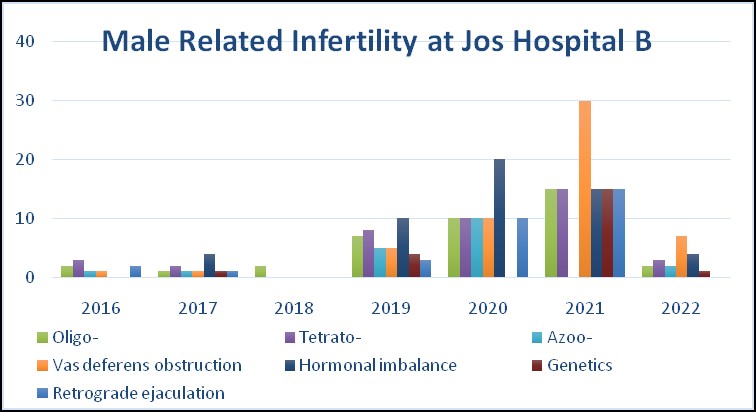
Purpose: Infertility, defined as failure to conceive after one year of unprotected sexual intercourse, remains a major reproductive health challenge with significant social consequences in sub-Saharan Africa. It has multifactorial causes involving both male and female factors. This study evaluated infertility etiologies and assisted reproductive technology (ART) practices in Abuja and Jos, Nigeria, between 2016 and 2022. Methods: A retrospective review of 26,233 patient records from four fertility hospitals (two in Abuja and two in Jos) was conducted. Data extracted included patient demographics, identified male and female infertility factors, and ART utilization patterns. Statistical analysis was performed to compare regional variations in infertility etiologies. Results: Of the 26,233 records analyzed, 14,590 (55.6 %) were from Jos and 11,643 (44.4 %) from Abuja. Among males, azoospermia and oligozoospermia were the most prevalent causes of infertility, with the highest azoospermia burden recorded at Abuja Hospital B (22 ± 4 cases). Female infertility was predominantly associated with polycystic ovarian syndrome (PCOS) and tubal disease, with Abuja Hospital B reporting the highest number of PCOS cases (143). Significant regional variation was observed in male infertility, particularly azoospermia (F = 5.622, p = 0.014), whereas female infertility rates did not differ significantly between the two locations. Variations were also observed in ART utilization patterns across the centres. Conclusion: Male infertility, especially azoospermia, showed significant regional differences between Abuja and Jos, while female infertility patterns were relatively similar. These findings highlight the need for region-specific reproductive health strategies and improved access to ART services in Nigeria.Downloads
References
1. Practice Committee of the American Society for Reproductive Medicine. Definitions of infertility and recurrent pregnancy loss: a committee opinion. Fertil. Steril. 2020;113(3):533-535.
2. Ofovwe CE, Agbontaen-Eghafona KA. Infertility in Nigeria: A risk factor for gender-based violence. Gend. Behav. 2009;7(2):2326-2344.
3. World Health Organization. WHO fact sheet on infertility. Glob. Reprod. Health. 2021;6(1): e52.
4. Inhorn MC, Patrizio P. Infertility around the globe: new thinking on gender, reproductive technologies and global movements in the 21st century. Hum. Reprod. Update. 2015;21(4):411-26.
5. Oyuyo C. Psychological Impact of Perceptions of Infertility and Childlessness: A Systematic Literature Review (Doctoral dissertation), California Southern University; 2024; DocuSign Envelope ID: B00E686F-37E2-4947-BEE6-9C7050B0FA5D
6. Agarwal A, Selvam MK, Ambar RF. Validation of LensHooke® X1 PRO and computer-assisted semen analyzer compared with laboratory-based manual semen analysis. World J Mens Health. 2021; 39(3): 496.
7. World Health Organization. WHO laboratory manual for the examination and processing of human semen. 6th ed. WHO Press; 2021.
8. Mascarenhas MN, Cheung H, Mathers CD, Stevens GA. Measuring infertility in populations: constructing a standard definition for use with demographic and reproductive health surveys. Popul. Health Mtr. 2012; 10(1):17.
9. Kasna S, Agrawal SS. Infertility in Women: A Review on Causes, Treatment, and Management. IJMB. 2022;8(2):30-38.
10. Ombelet W. Global access to infertility care in developing countries: a case of human rights, equity and social justice. Facts, views & vision in ObGyn. 2011;3(4):257.
11. Anderson DJ. Sexually transmitted infections and infertility. J. Reprod. Immunol. 2014;100(101-102):13.
12. Bakare B, Gbala MO, Oke OF, Adeniyi AA, Olanrewaju BO, Akinsipe CI, Oluwayomi SG, Olofinbiyi BA. In Vitro fertilization in Nigeria: A critical review of challenges, successes, and future directions. Int. J. Gynecol. Obstet. 2024;6(2):56-60.
13. Adewale MO, Adeleye AO, Olayemi O. Access to infertility treatment services in Nigeria: Challenges and opportunities. Niger Med J. 2020; 62(4), 201–207.
14. Omisakin SI, Ugwu AO, Adebayo A, Araotan K, Ayodeji OA. Epidemiology of Infertility and Characteristics of Infertile Women Requesting Assisted Reproduction Techniques in a Low Resource Setting in Western Nigeria. Int J Trop Dis Health. 2024;45(10):10-9734.
15. Ottun TA, Adewunmi AA, Jinadu FO, Olumodeji AM, Akinlusi FM, Rabiu KA, Akinola OI, Fabamwo AO. A decennial cross-sectional review of assisted reproductive technology in a Tertiary Hospital in Southwest Nigeria. BMC Pregnancy Childbirth. 2023;23(1):680.
16. Ogundele OA, Okonkwo JE, Ajayi RA. Regional variations in the diagnosis of male infertility in Nigerian tertiary hospitals: A multicenter study. Niger. J. Clin. Med. 2022; 24(1), 44–53.
17. Obajimi GO, Saanu O, Ilesanmi AO. Expanding access to assisted reproductive technology in a developing country: getting more for less. Afr. J. Med. Sci. 2021;50(2):171-5.
18. Abebe MS, Afework M, Abaynew Y. Primary and secondary infertility in Africa: systematic review with meta-analysis. Fertility Research and Practice. 2020;6(1):20.
19. Zabak S, Varma A, Bansod S, Pohane MR, Varma Sr A. Exploring the complex landscape of delayed childbearing: factors, history, and long-term implications. Cureus. 2023;15(9).
20. Liang Y, Huang J, Zhao Q, Mo H, Su Z, Feng S, Li S, Ruan X. Global, regional, and national prevalence and trends of infertility among individuals of reproductive age (15–49 years) from 1990 to 2021, with projections to 2040. Hum. Reprod. 2025; 40(3):529-44.
21. Brodeur TY, Grow D, Esfandiari N. Access to fertility care in geographically underserved populations, a second look. Reprod. Sci. 2022;29(7):1983-7.
22. Obeagu EI, Njar VE, Obeagu GU. Infertility: Prevalence and consequences. Int. J. Curr. Res. Chem. Pharm. Sci. 2023;10(7):43-50.
Downloads
Published
Issue
Section
License

This work is licensed under a Creative Commons Attribution-NonCommercial-ShareAlike 4.0 International License.